
What Is A Hybrid Solar System?
Solar power systems come in three varieties; on-grid, off-grid, and hybrid. A hybrid solar system has the good features of both on-grid and off-grid solar systems, minus their flaws.
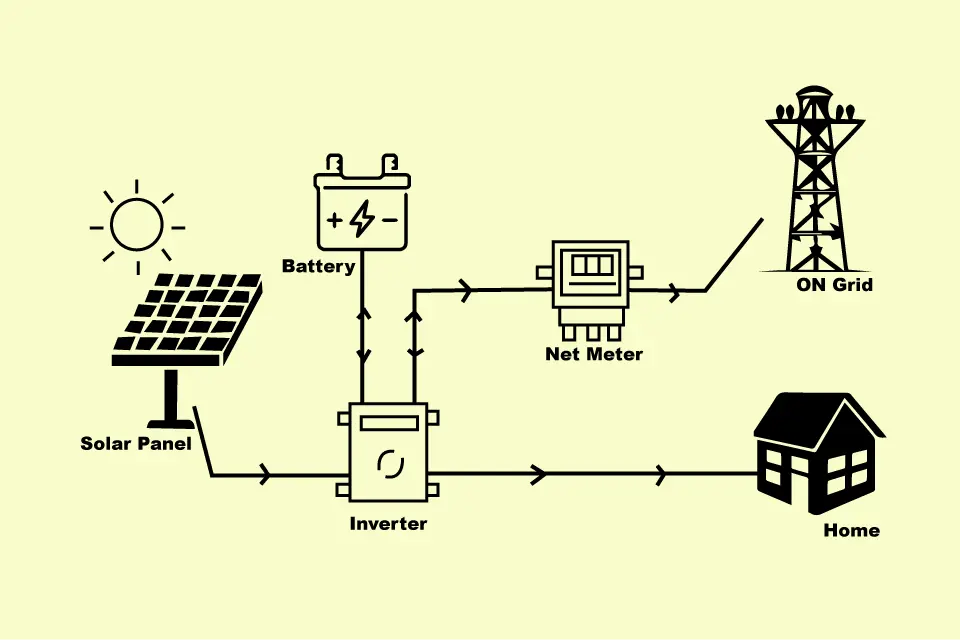
The hybrid solar system is connected to the grid via net metering and also has a battery backup to store the power. The energy that solar panels collect goes through a hybrid solar inverter to generate electricity.
The most important benefit of a hybrid solar system is the power backup facility. It means you can continue using electricity without disruptions even during power outages. A battery backup helps store the extra power generated by the solar system during peak hours.
Bear in mind that:
- A hybrid solar inverter is used more than a standard battery inverter in a battery-ready system.
- The modern hybrid solar inverter comes with a charger and a built-in connection.
- Owing to its benefits, a hybrid solar inverter is naturally more expensive than a standard battery inverter.
Components In Hybrid Solar System
The hybrid solar system has four elements:
- Solar Panel : Solar panels are used to convert solar energy into DC electricity. The solar panel is an essential component of the solar system.
- Hybrid Inverter: It is the second important component in a solar system. The hybrid inverter regulates the voltage and converts DC to AC voltage which can be later used to power household appliances.
- DCDB: The direct current delivery box has a fuse, SPD, and MCB for security. The DCDB connects multiple solar panel wires into a string with positive and negative outputs.
- Charging Controller : The charging controller enhances the battery life by controlling the quantity of power going inside the battery.
Types Of Hybrid solar inverters
The most cost-effective hybrid solar system employs a basic inverter which includes a hybrid solar inverter and a charger. It also comprises smart controls for the most efficient use of the provided electricity.
There are four main types of hybrid solar inverters;
- Basic hybrid solar inverter
- Multimode hybrid solar inverter
- All-in-one Battery Energy Storage System (BESS)
- Advanced AC coupled system
Basic hybrid solar inverter
This is the most common type of hybrid solar inverter that allows storing solar energy in a battery. However, it cannot be reliable during power cuts because it is not connected to a grid system.
Multimode hybrid solar inverter
This is an advanced hybrid solar inverter with a built-in backup or a separate unit. You can charge the batteries and use them during a power cut.
All-in-one Battery Energy Storage System (BESS)
The BESS is the new hybrid solar inverter with batteries and the inverter. This system can be adapted to any existing solar system without any difficulty.
Advanced AC coupled system
AC coupled systems are widely used solar batteries. They have a hybrid solar inverter for charging the battery. These rechargeable batteries are simple to use; however, they are less efficient than their DC-coupled system. AC coupled systems are used to power AC loads, and the efficiency can be expanded by using multiple hybrid solar inverters.
Advantages Of Hybrid Solar Inverters
- A hybrid solar power system comes with batteries. This provides an uninterrupted power supply even during a power outage.
- Solar power connected to a battery system ensures the maximum use of solar energy; thus, saving a lot on your electricity bills.
- Compared to conventional energy sources, a hybrid solar inverter does not require routine maintenance because it does not use gasoline.
How Does A Hybrid Solar System Work?
A hybrid solar system is reliable because it supplies constant electricity. Below are steps that explain how this system works:
- The panels absorb the sun rays during the day, converting them into electricity and storing the excess energy in the batteries. If any extra energy remains after using the required power, the excess amount is sent back to the grid via net metering.
- The batteries are rechargeable. If the power is cut for too long, the batteries can be recharged from the grid